Dot to dot for kids: which level for which age
As a rule of thumb, give a four- to five-year-old about 25 dots, a six- to eight-year-old about 50, and a child of eight or more 90 or more. The dot count matters, but so do the size of the numbers and the space between the dots: a 50-dot page with big, well-spaced numbers is easier than a cramped page of 30.
These ranges are a starting point, not a rule. A child who already counts past 100 can skip ahead; a child who finds the next number slowly needs fewer dots, whatever their age. US kindergarten standards ask children to count to 100 by the end of the year, and finding the next numeral on a busy page is harder than counting aloud.
What makes a dot to dot easy or hard
Four things decide how hard a page is, and the dot count is only one of them:
| What | Easier | Harder |
|---|---|---|
| Dots | 10–25 | 90 and more |
| Numbers | Large, about 5 mm tall | Small, about 3 mm tall |
| Spacing | Far apart; the next dot is easy to spot | Close together; neighbours compete |
| Shape | A simple outline (a cat, a fish) | Lots of small turns (hands, a group of people) |
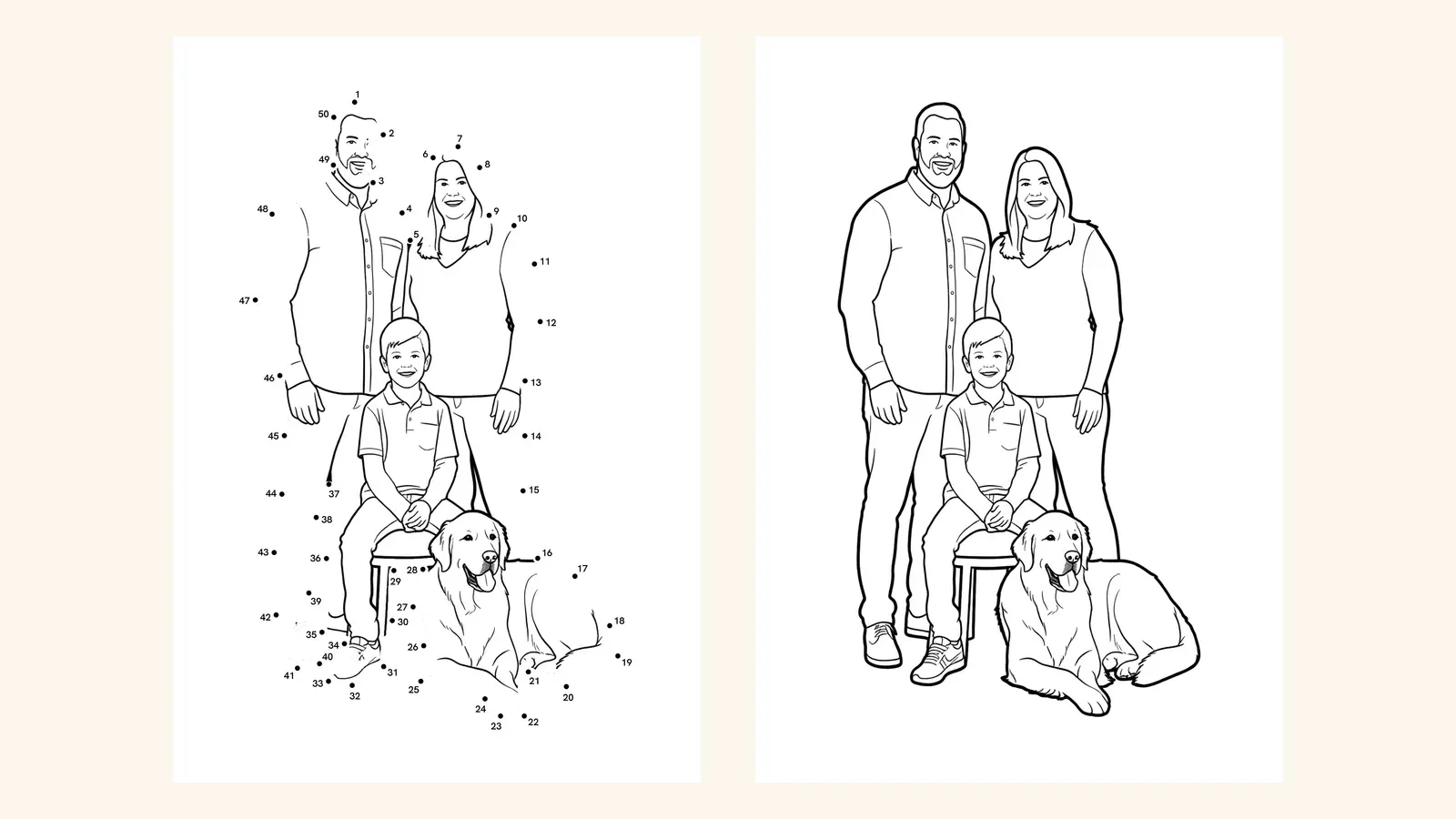
The last row is easy to miss. The page in the picture above has 50 dots, but it outlines three people and a dog, so the line doubles back on itself around the feet and the chair. A child who manages 50 dots around a cat may get lost there.
Dot count by age
| Age | Dots | Numbers | What they are practising |
|---|---|---|---|
| 3–4 | Up to about 10–15 | Very large | Recognising numerals 1–10, holding the pencil |
| 4–6 | About 25 | Large (about 5 mm) | Counting to 20 and beyond, finding the next number |
| 6–8 | About 50 | Medium (about 4 mm) | Number order to 50, straight lines over a distance |
| 8+ | 90 and more | Small (about 3 mm) | Patience, careful work on a busy page |
For context, the US Common Core standards expect children to count to 100 by the end of kindergarten (age five to six) and to write numbers from 0 to 20. Counting aloud comes before finding numbers on paper, so a page for a kindergartner should stay well below 100 dots.
Signs a page is too hard (or too easy)
- Too hard: the child asks “where’s the next one?” at most numbers, joins dots out of order, or gives up halfway. Drop a level, or print the same picture with fewer dots.
- Too easy: finished in a minute and asks for another. Move up a level, or switch to a different kind of puzzle, such as a maze.
- Just right: a few pauses, finished in one sitting, and they want to colour it in afterwards.
Tips for printing pages kids can finish
- Print at full size. Choose “Actual size” or 100% if the page matches your paper (A4 or Letter), and “Fit to page” only if it does not. Shrinking a page makes small numbers harder to read. The coloring page print size guide covers those settings, and image resolution for printing is the chart for how many pixels a sharp print needs.
- Use a pencil first. Mistakes can be rubbed out; pens can come later.
- Keep the answer page. If a child gets stuck, the finished picture shows where the line is meant to go, without giving away the next number.
- Colour it afterwards. The joined-up outline is a colouring page, which turns a ten-minute puzzle into half an hour of quiet.
Making a page from your own photo
Children try harder when the picture is someone they know. Our dot to dot generator from photo turns a photo of a pet or the family into a printable page, like the one at the top of this guide. You choose one of three levels:
- Easy: about 25 dots, big numbers, for ages 4–6;
- Medium: about 50 dots, for ages 6–8;
- Hard: about 90 dots and smaller numbers, for ages 8+.
The page comes on A4 or Letter at 300 DPI, as a PDF with an answer page. The dot count is a target: a short, simple outline may get fewer dots, because the dots are never put closer together than the level allows. Pets on their own work best; a group photo keeps only the outer shape on Easy.
If a child finishes dot to dots easily, the picture maze generator makes a maze in the shape of the same photo, with levels from age 3 upwards.
Frequently asked questions
- At what age can kids do dot to dot?
- Most children can manage a simple page of 10 to 25 dots at around four, once they recognise the numbers on it. Pages of 50 dots suit most six- to eight-year-olds, and 90 or more suits children who count confidently past 100.
- How many dots should a dot to dot for a 5-year-old have?
- About 20 to 30, with big numbers and plenty of space between the dots. US kindergarten maths standards expect children to count to 100 by the end of the year, but reading the numerals and finding the next one on a busy page is harder than counting aloud.
- Are dot to dots good for children?
- They practise number order, hand control and pencil grip in one go, and children like that a picture appears at the end. Choose a page they can finish; one that is too hard teaches nothing.
Making this yourself? dot to dot generator from photo is the quickest way to start.